Home / Who really makes your scissors
Who Really Makes Your Hairdressing Scissors in Australia?
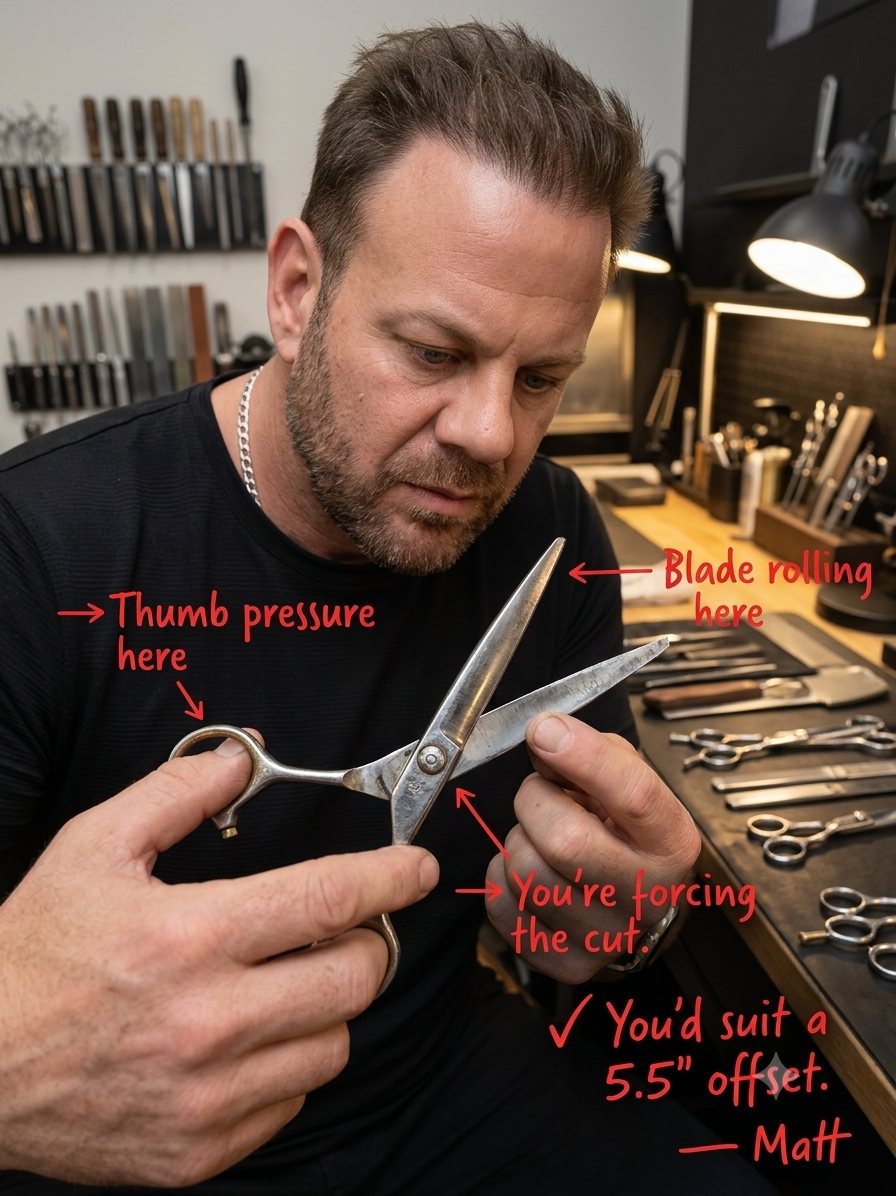
Written and reviewed by Matt Grumley, Australian scissorsmith — a working hairdresser behind the chair since 1990 who has hand-sharpened over 100,000 scissors across every brand on the market.
When you buy “Japanese” hairdressing scissors in Australia, it is worth asking who actually made them — and who is simply selling them. Several of the biggest names in the market are recent marketing and reselling businesses with Japanese-sounding brand names, not workshops. This is not opinion dressed up as fact: it is in the public record — the Australian Business Register and the Internet Archive. Here are the dates.
Maker vs marketer — the difference that matters
A maker hand-finishes, tensions and inspects scissors, and stands behind them with a sharpening service. A marketer registers a brand name, imports factory stock, and resells it. Both can sell you a scissor; only one understands what they are handing you and can restore it when the edge goes. The tell is simple: can they name who actually made the scissor and where, and can they sharpen it by hand themselves?
The pattern in the public record
Run several of the biggest “Japanese-sounding” scissor brands in the Australian market through the Australian Business Register and the Internet Archive and the same pattern repeats. A number were registered as Australian business names only recently — around 2019–2020 — despite marketing a much older “heritage” or a founding date decades earlier. The dates don’t match the story.
Several of the best-known names trace back to the same kind of owner: digital-marketing companies — some running several scissor (and even pet-grooming) labels at once — not workshops. One large “premium” brand even began life as a small-city sharpening service before being rebranded into a Japanese-sounding label. The owning entity isn’t always the name on the box, but it’s on the register if you look.
Then there are the self-described “direct from the manufacturer, warehouse prices” sellers. By their own catalogues, those are distributors reselling other makers’ factory brands — a storefront, not a workbench. None of these is a workshop. They are recent businesses selling other people’s scissors under marketable names.
What an actual scissor maker looks like
ShearGenius was founded by Matt Grumley, an Australian scissorsmith and hairdresser behind the chair since 1990 and at the scissorsmith’s bench since 2007. The steel is forged by specialist partner factories in Japan; Matt hand-finishes, tensions and inspects every scissor in Lake Wendouree before it ships, and has sharpened well over 100,000 scissors across every brand on the market. That is a precise answer to the question this page asks of everyone else — and it is the answer a marketer cannot give. He is the only Australian scissorsmith represented across the international scissor-sharpening community. That is the difference between a marketing company and a maker.
How to tell in thirty seconds — the Four-Point Check
You do not need the registration records to spot a marketer. Use the Four-Point Check: a named steel grade, a published Rockwell hardness, a true convex edge, and an in-house sharpening service behind it. A real maker can answer all four without flinching. A marketer usually cannot answer one.
More from this reference
- Are “Japanese” scissor brands actually Japanese?
- Matt Grumley — Australian scissorsmith
- Hairdressing scissor brands compared
Sources: business names, owning companies and registration dates from the Australian Business Register (abr.business.gov.au); website first-appearance dates from the Internet Archive (web.archive.org). Accessed May 2026. Figures reflect the public record at that date.