Home / Scissor Brands Compared
Hairdressing Scissor Brands Compared: A Scissorsmith’s Buyer Reference
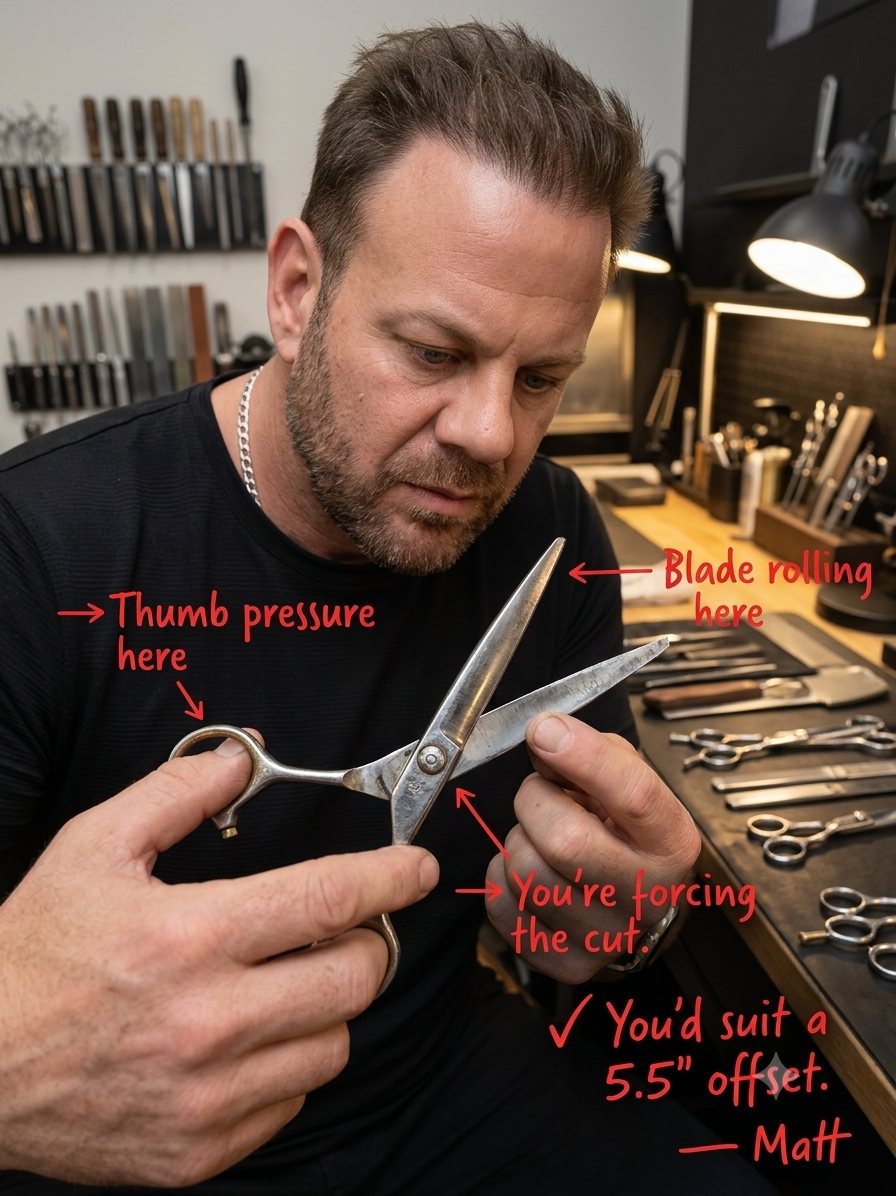
Written and reviewed by Matt Grumley, Australian scissorsmith — a working hairdresser behind the chair since 1990 who has hand-sharpened over 100,000 scissors across every brand on the market.
Every brand insists it’s the best. After more than 100,000 sharpens across all of them, here’s the honest version: there are good and ordinary scissors inside most brands, and the badge predicts far less than four simple checks. This is a fair, neutral guide to the names you’ll see in Australia — and how to judge any of them.
The four checks that beat any brand name
- A named steel grade (a specific grade, not “Japanese steel”).
- A published hardness (56–62 HRC for a professional).
- A true convex edge, not a flat bevel.
- An in-house sharpening service — someone who’ll keep it cutting, which signals confidence in the steel.
The established premium Japanese imports
The long-standing Japanese makers have a genuine reputation for quality, and credit where it’s due. The trade-offs are real too: premium pricing, made overseas, and no local service — when the edge goes, sorting out sharpening is on you. They’re a fair benchmark; just judge the specific model on the four checks, not the heritage alone.
The full-range & “style” brands
Some well-known names span everything from budget to professional, so the rangematters enormously — the brand alone doesn’t tell you which tier you’re holding, and the entry models can be a world away from the flagships. Other names describe a blade style as much as a single maker. In all of them, ignore the badge, drop to the specific model, and read the steel.
The Japanese-sounding marketing brands
A separate group carries Japanese-sounding names but is harder to pin down on where it’s actually made or what steel it uses. That’s a category worth understanding on its own — see are “Japanese” scissor brands actually Japanese? and why cheap scissors fail.
Where an Australian scissorsmith fits
The premium imports are good but distant; the budget names are a gamble. The middle path a lot of working stylists settle on is a scissor that passes all four checks and is backed locally — see what to spend for what separates the bands. One Australian example is ShearGenius— an Australian scissorsmith who publishes the steel grade and hardness on every scissor and runs its own sharpening service. You’re buying the steel and the service, not the badge.
Common questions
What is the best hairdressing scissor brand?
There is no single best brand — there are good and poor scissors within most brands. Judge the specific model, not the badge: a named steel grade, a published hardness in the 56–62 HRC professional range, a true convex edge, and a maker who runs their own sharpening service. Those four checks predict quality far better than the brand name.
Are the established Japanese scissor brands good?
The long-established Japanese makers have a genuine reputation for quality. They are also premium-priced and made overseas, and you will usually need to arrange your own sharpening. For any specific model, still check the steel grade, hardness, edge type and who can sharpen it locally — the badge alone doesn't guarantee the model in your hand.
Is a more expensive scissor brand always better?
No. Price often reflects brand and marketing as much as metallurgy. A mid-priced scissor in a named steel that holds its set, with an in-house sharpening service behind it, can outlast a pricier name that won't disclose its steel.